I'm trying to post a couple of stories I have here on blogger. I had to take a bit of a break since one of our supersession panelists Josh Bernoff stopped by. I'm in the NAB Science and Technology Office and NAB Office.
Josh is on the panel I'm moderating at 3:30 - Social Networking SuperSession in Room 222.
He wrote the book Groundswell about Social Networking and he's the VP Principal Analyst for Forrester.
Josh is hungry. I am too. We ask where to go? Janet Elliott from the NAB was kind enough to invite us to share the staff buffet lodged against one wall of their inner logistics office.
We see a work table with students and one guy. The guy has his back to us. I'm excited. I bet these are the students who will be on our panel to talk about social networking.
The guy turns around. It's John Gage, Chief Researcher & Director of the Science Office - Sun Microsystems. He's the SuperSession keynote at 3:30 in Room 222 and joining us for the SuperSession panel.
John Marino from the NAB gets us today for a minute. He pulls us over to his laptop.
He types in Josh's name in a browser. He does mine too. Oh my goodness....you have to see what he's going to show off at 3:30 pm. I can't wait to play with the website after the session.
Unfortunately, I can't post the URL(s) until after the SuperSession. I can give you a hint...you better watch out what's on the Internet about you!
Students and executives on a panel, now this is going to be a blast! John Gage was so excited showing us some of the new things out there!
Cheers!
Peg
Peggy Miles
Monday, April 14, 2008

DTV Coverage Session
I attended the DTV Reception Issues Broadcast Engineering Conference Session at 10:30am today. It was full of interesting quantitative planning factors that one should use in predicting coverage changes post the Feb’09 DTV transition. The numbers came too fast to capture and I will have to purchase the conference proceedings so I have access to the details. My interest in this topic comes from work I have been doing with Centris (Google Centris and DTV coverage for details) to understand the consumer experience following the DTV transition. I came to the independent realization that with over 70% of OTA TVs on indoor antennas, the FCC planning factors for DTV coverage of an outdoor 30 foot high direction gain antenna would not provide a reliable predictor of coverage. As Bill Meintel pointed out in his presentation, it is the cliff effect in DTV that makes the difference. People who currently have acceptable analog performance may not find any DTV signal post transition. In fact, just before NAB I got my NTIA converter box coupons and find that while I can pick up all my VHF channels as DTV, all my analog UHF channels are not watchable in digital form with an indoor antenna. As stated by Bill, the adjustments one must make to coverage prediction to the FCC’s LR OET69 model for DTV included:
· Corrections for other than 30 foot antenna height
· Corrections for indoor coverage due to building penetration loss as a function of where in the house the antenna is located· Multipath, with separate factors for static and dynamic
· Local noise, especially at VHF
· Receiver performance variation, especially equalizer complexity
Bill gave typical, best case, and worse case data for each adjustment that should be helpful to anyone who tries to accurately predict DTV coverage.
Telestream Announces ProRes 422 Support
Thanks to NABfeed at Twitter for the heads up. This is huge news for Final Cut Studio users working with ProRes 422 as their conforming and mastering codec. Here's a snippet from the press release:
Las Vegas, Nevada, National Assn of Broadcasters (NAB) Convention, April 13, 2008 –Telestream today announced availability of Episode 5.0 encoding software which expands format support to a greater number of specific digital media workflows for Apple professionals. For high-end post-production workflows, Telestream’s high-performance Episode Engine server software adds input support for RED camera, Cineon and DPX formats. For its core content repurposing to Web and mobile workflows, the entire Episode family adds support for the latest Flash 8, Flash 9 and Blu-ray formats. For Apple’s new Final Cut Server media asset management and workflow automation software, Episode expands format choices beyond QuickTime to virtually any format.
Additional awesome highlights include Final Cut Server integration, RED Camera format support, and support for the latest Blu-ray formats. Stop by the Telestream Booth SL5405 for more details.
It appears that the future is now.
proactively • peter
Monday Openning Session
It’s Monday time to get to work. I had an 8am breakfast with a client at The Flamingo and still time to catch the Monorail to the LVCC in time for the 9:00am opening session. The only problem is to figure out where it is. I like everything about this show except the lack of availability of conference schedule and room info. I have no idea where the session is being held and nor does anyone of the dozens in my monorail car. I looked for the info all last night on the NAB website and it was nowhere to be found. The NAB show daily has the secret hidden on page 58 so I head over the Barron Room of LV Hilton and although 15 minutes late it has still not started. While many think these awards focused general sessions to be content light, I find the list of issues and priority given is insightful. I was not disappointed. David Rehr (NAB president) leads off with mention of You Tube as an example of rapid changes the industry is facing and makes the point that although change is not always welcome, it can be the source of new opportunities that can have an upside if you recognize the change and adjust your business to take advantage of the new environment rather than be a victim. The You Tube examples shown were very funny by the way. David continued with the not surprising wake up call the DTV is coming (fast!) but he stopped short of a recipe for how to align business in such a way to gain advantage. Instead he gave the example that although radio had been written off, it has been re-invented and it actually growing. The implication is that the same is possible for TV. Examples of how radio is dealing with change were provided as food for thought as to what TV might do. One radio example is that auto OEMs are offering HD in new cars. David continued that availability, or push, is not all that needs to be done. He described a promotion called “Radio Here” to create consumer demand pull as well. Switching back to an acknowledgement of current tough times for OTA broadcast TV, David described a program of consumer education that will lead to an average of 642 exposures/household of DTV education between now and the Feb’09 transition. The unstated implication is that DTV improved signal quality and increase in OTV program choices will lead to improvement in business for broadcaster. However the home run for me was his next topic of TV to mobile devices. With 345 mobile devices as possible platforms for OTA DTV reception, to me this represents some real opportunity. NAB efforts in this regard are participation in industry groups such as Open TV Coalition to get standards compatible with mobile handsets such as Advanced ATSC adopted. Left unsaid however was how advertising supported OTA TV would position itself relative to subscription models such as MediaFLO and perhaps new offerings by Echostar on their recently won simple spectrum. Just before breaking for the awards part of the session, David offered a not surprising admonition that broadcasters must make “the internet part of their DNA”. He concluded with a review of NAB lobbying efforts in performance tax, DTV education, opposition to the XM-Sirius merger, fighting white space allocations, and increasing visibility of the importance of localism. My objective in attending this session was worthwhile and I found of particular interest the viability of delivery of OTA TV to mobile devices to be a possible big win for existing broadcasters.
If you have an interest in the impact of storage on image capture devices, stop in to hear my presentation Tuesday morning at The Creative Storage Conference (an NAB partner event).
Stu
If you have an interest in the impact of storage on image capture devices, stop in to hear my presentation Tuesday morning at The Creative Storage Conference (an NAB partner event).
Stu
StandBy! TV is broken!

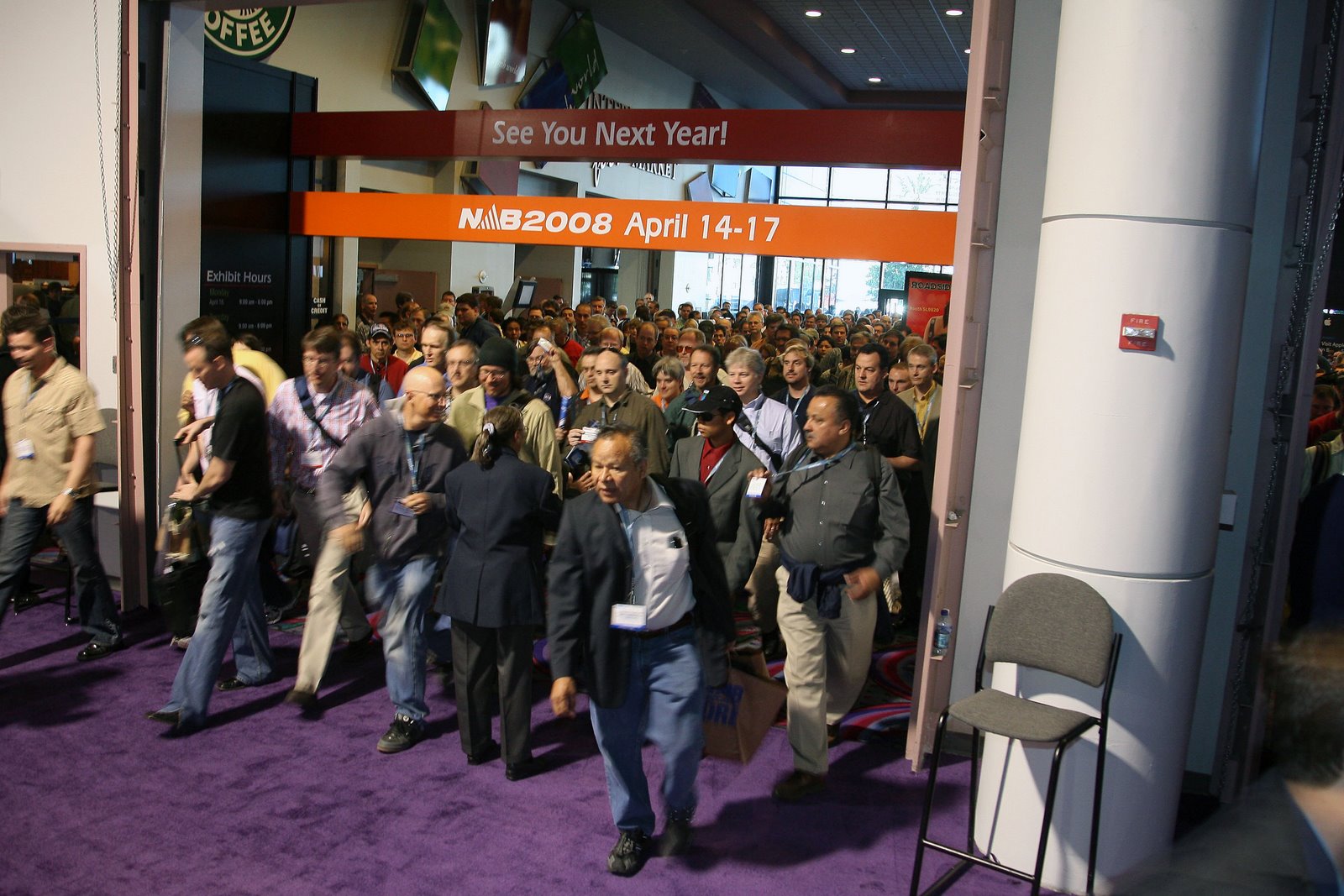
We’re on our way as the doors are now open for the exhibits and sessions at NAB 2008! We can take down the “stand by” screen for NAB 2008. Welcome.
Then again, I was told that TV is broken!? What??? You be the judge. Read on....
Do you remember seeing this screen on TV? Maybe someone mentioned this screen to you? This graphic "please stand by" was often seen on early black and white TV broadcasts whenever a station had technical problems.

The solution to all these early TV problems came from people just like you - - - National Association of Broadcast members, conference attendees, engineers and innovators around the world took us to the next level.
(We still had stand-by screens in the days of color. You may have seen the color bars flash up on TV at various times. It's very rare to see problems over terrestrial TV channels today.)
We're not finished with the stand-by screen yet.
We’re seeing the same “problem-fixing” happening with the new “TV” on the net, on-line, on-air, anywhere on any device, a digital sign, or e-paper. The stand-by screens of today might be a little more colorful, and if there’s a glitch, we throw in a commercial, a promo or another video to cover the problem.
TV is Broken? The Innovation Transition
Richard Bullwinkle, on the founding team of TiVo, now at MacroVision told me, “TV is broken”. What he meant, I believe was that TV is evolving, but to the next generation, the TV of today will appear as very “broken!” I’d rather say we’re making it better.
Thomas Edison broke a lot of light bulbs on his way to electricity, but I would not relate his work to being “broken”.
Richard was emphasizing a point rather than telling us we are messing up. It’s important to say things need a little work, and are broken, as it provides the opportunity to get vendors and engineers to "fix" things, and more importantly we're responding to our listeners, viewers and multimedia consumers.
Bottom line. We’re innovating…and inventing, call it 'whatever', there is amazing work being done today. Broken, not a chance.
(Bullwinkle shared with me their latest Harris Interactive study hot off the research desk. I’ll pass on some stats/graphs in a few days since ironically this blogger is “broken” and having delays on posting images. I agree with Bullwinkle's thoughts, it's a sematics issue. Is it a half full or half empty?
Bye Bye “Stand By” screen? Not Yet.....
This “stand by’ graphic with the indian head is now only seen in books, museums or on the Internet. This once common screen to viewers in the United States is no longer in use.
It’s NOT really gone.
Today - we have our own version of stand-by screens. My Cable DVR always tells me to wait. A webcast or an on-demand video on the net, phone often displays a blank screen and the all too common words, "buffering" or "connecting" Other times, you'll get an error box saying a number of things, stream not found, a gibberish number, error message, downloading or even worse, your system stalls, sometimes calling for a reboot.
Here's a CNN graphic that is hard to see. It says that the live video will be up in the morning. It's not broken, even if your teen-ager thinks it's broken when they click on something and get a message like this.

Who would have have thought I'd be rebooting my TV? I do that every couple of weeks when my cable company or their cable set top box can’t manage the issues. Comcast is my provider, but they are not alone in solving these problems. In fact, I just got an email from Andrew Olsen from Comcast who is on his way out here, a great friend to digital media efforts, and was one of the people behind "theplatform.com" and a digital media innovator.
Let’s not forget pixelation, where the screen is garbled with tiny squares of gibberish, blips seen then and again Digital TV or Digital Terrestrial TV channels. Then there’s latency which is the waiting and waiting for the video to start playing on IPTV and other gadgets. Mobile TV and portable media viewing have their issues, but it’s amazing the difference if you look at today and ten years ago. It’s incredible what you, now the new media innovators have done!
And to our pioneering media friends, I haven’t heard of any system running 24/7 with 100%, or close to the reliability we have seen in years past on terrestrial TV.
We’re getting closer to the day when you click on any device, anywhere, your media will play instantly. The “stand by” screen that says “buffering”, “loading” “downloading” or “please wait” “rebooting” will be a thing of the past. Your children or grandchildren will never know of the problem.
It's amazing to think that we're going to have to explain to our children, or grandchildren that video came in on this big thick box, about a foot or so deep. Inside was a huge tube. They won't know what buffering means, and won't believe you when you tell them there were only a hanful of TV channels (or a few thousands) when you were young.
They will be upset if they click (or ask for) a live or on-demand program to begin and it doesn't start instantly. They'll be able to access their content anywhere, or their favorite display, at home, at work, in the car, at play.
Right now, I’d be happy to have Internet access or a cell phone that works in the convention center.
I had to stop writing and editing this because John Gage came in and was showing us different websites he likes. Blogging or John Gage. Good thing, this was getting way too long...and stand by!
Peg
peggy miles
see you on the Net
NAB Content Creators Party
I hit the NAB & FMC Content Creators Party on Sunday night (yes I'm lagging a little behind). The event was a great mix of people attending educational sessions at NAB as well as industry pros. The open air terrace let folks mingle and the party got quite lively. I had to smile as I heard multiple people commenting that 'This is an NAB Party?'
 It wasn't a dig... but rather a sign of how things are changing. Great networking, great location, and creative entertainment. Kudos to the organizers and attendees for putting on such a different event. In the course of one night I managed to talk to Hollywood Film Editors, Software programmers, New Media Producers, and even a DoP from my days in Des Moines, IA.
What a great start to the week!
Sunday, April 13, 2008
Plans for Monday 14April
I is a good thing this blog has a back door. Yesterday I had no problem posting from IE from my MAC. Today Google must be angry at Apple and says I can not post unless I allow cookies (I do but they don't acknowledge that). However, they do support my posting via a back door if I send a regular email to a special address so here we go.
The long ride from Boston is now behind me and I need to get serious about planning my Monday. With so many educational events of interest I don't expect to get to the show floor on Monday. I have breakfast meeting with a client and then off to the 9:00am State of the Industry Address. It is a good thing I my body clock is homed to Boston so it will be an easy up and out. These opening sessions are often a mixed bag of welcome-welcome again- and still more welcome; however, I find the topics mentioned make visible the key issues and priority in the year ahead and I find them worthwhile. I will be really surprised if less than half of the discussion is about the DTV transition.
The DTV transition is an important topic of interest to me so my first meaty session on my calendar is the 10:30am DTV reception issues session of The BEC. Just a few days before leaving for Vegas, I got my NTIA converter box coupons in the mail and headed off to Radio Shack to pick up two boxes. I expect my experience is not atypical-- the TV in the spare bedroom is not hooked to cable but gets good off-the-air pickup with the monopole antenna build into the TV. When an external rabbit ear antenna is hooked to the converter box, I get acceptable off-the-air reception on the V's but an un-watchable in and out program on all the U's. I would hate to be in congress when the bulk of the public discovers they need an outside antenna or a shift to cable/DBS to continue watching TV.
Next I plan to attend the 1pm Cool Gadgets-Hot Content session followed by the 2:30pm Digital Innovation Session.
I expect to end the day attending the A-VSB press conference on mobile TV and if lucky will get a seat on the tour bus to watch TV and we drive through Vegas.
Planning my day for Tuesday should be easy. I am speaking at an NAB partner event Tuesday morning ( http://www.nabshow.com/2008/conferences/sessiondetail.asp?id=1207865 ). This event is called the Creative Storage Conference and details of the agenda are at http://www.creativestorage.org/2008Agenda.htm . I am speaking in the morning starting at 8:15 at a session called "Storage in Content Capture and Creation" (Las Vegas Convention Center N119). If you are interested in my topic see the abstract at http://www.creativestorage.org/2008/Book/Stu Lipoff.pdf . My subject area is the possible impact on storage requirements in next gen ENG and Digital Cinema cameras resulting from supporting image enhancing post production techniques. I will be showing a variety of before and after photos to demonstrate the value of this post processing.
Time to rest up-- the good thing about the time zone change is it is easy to get up in morning. The bad thing is my body clock says it is 1:30am. Nite-Nite.
Stu
Subscribe to:
Posts (Atom)